E-E-A-T stands for Experience, Expertise, Authoritativeness, and Trustworthiness. Google uses this framework to evaluate whether search results appear useful, reliable, and appropriate for the people conducting the search.
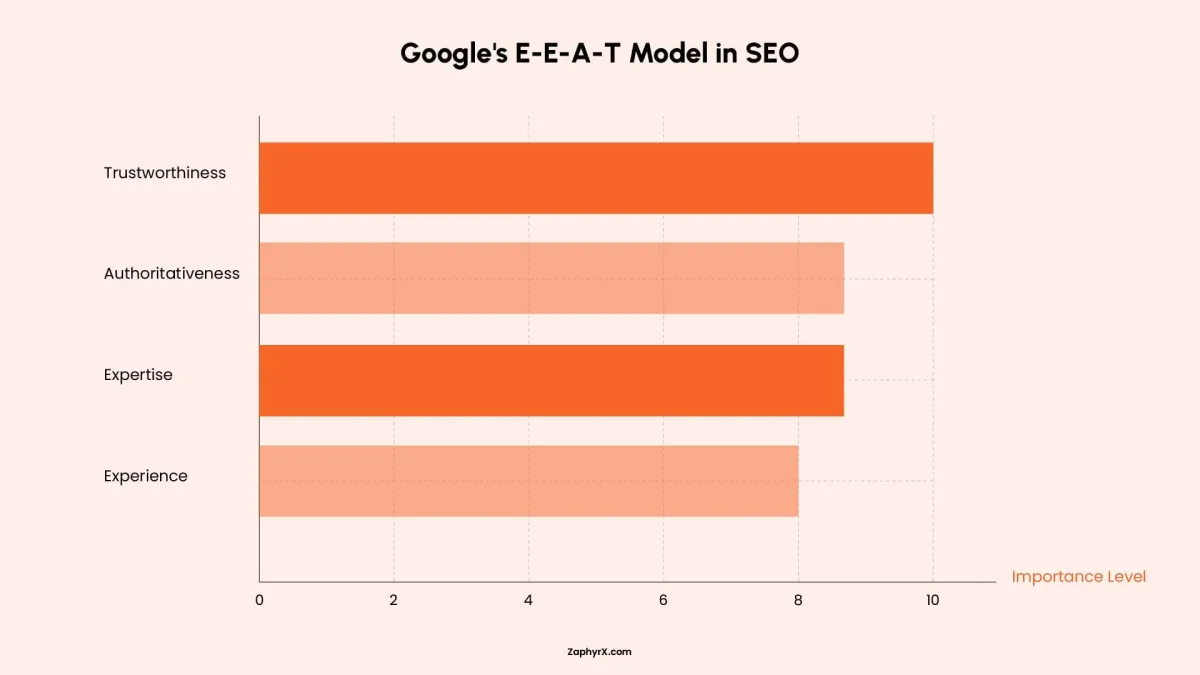
Google’s automated systems evaluate a combination of signals that may indicate these qualities. Google also states that Trust is the most important component, while Experience, Expertise, and Authoritativeness work together to help establish it.
If your website publishes content that influences important decisions, such as healthcare, finance, legal advice, or major purchases, demonstrating strong E-E-A-T becomes even more important. It helps build credibility with both search engines and potential customers.
In this guide, you’ll learn what each part of E-E-A-T means, why it matters for SEO, how Google evaluates content quality, and the practical steps you can take to strengthen your website’s credibility and improve its long-term search performance.
Key Takeaways
- E-E-A-T helps Google understand whether content is reliable, useful, and created by a credible source. It evaluates four areas: Experience, Expertise, Authoritativeness, and Trust.
- E-E-A-T is not a direct ranking factor, but it reflects the qualities behind high performing content. Websites that demonstrate credibility, accuracy, and real value are better positioned for long term search success.
- Experience is the major addition to the original E-A-T framework. Google now recognizes that first hand knowledge, real world examples, and practical insights can make content more valuable.
- Trust matters most. Strong authorship, accurate information, transparent business details, secure websites, and credible sources help users feel confident in your content.
- Google looks for evidence, not empty claims. Case studies, expert contributors, original research, citations, reviews, and industry recognition help prove credibility.
- AI generated content can succeed when it includes human expertise. AI can assist content creation, but original insights, expert review, and fact checking are what build trust.
- Improving E-E-A-T requires consistent effort. Publishing helpful content, strengthening your reputation, and showing clear evidence of expertise build credibility over time.
What Does Google E-E-A-T Mean?
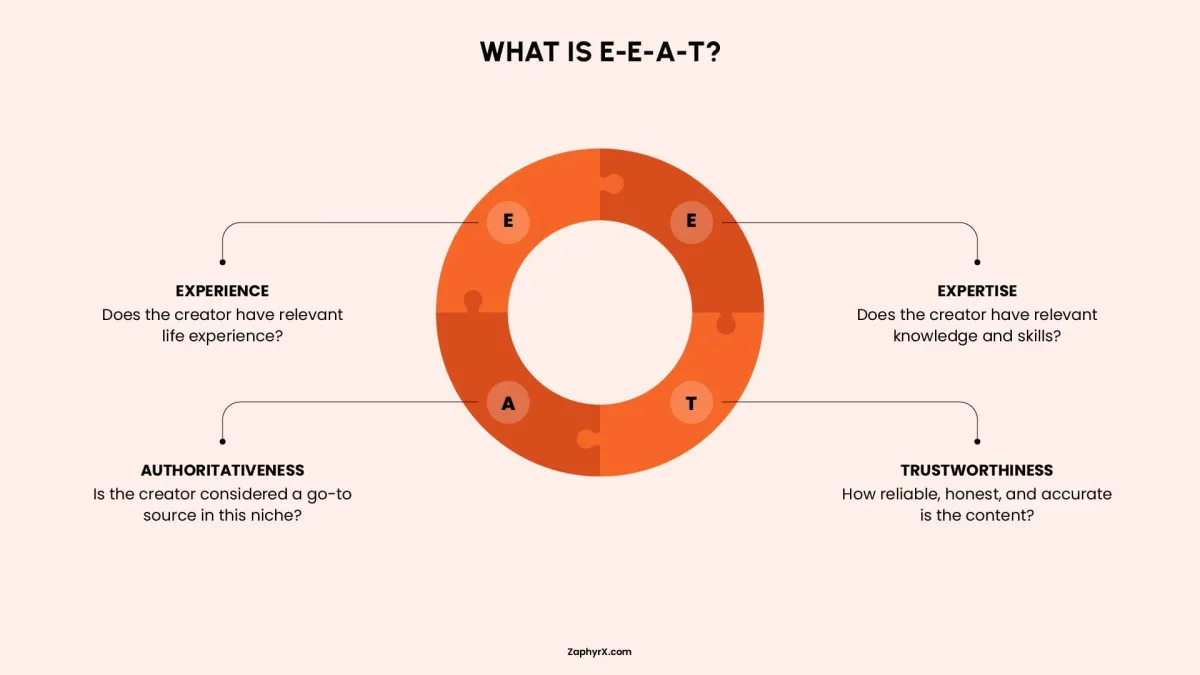
Google E-E-A-T stands for Experience, Expertise, Authoritativeness, and Trust. These four signals help Google’s human quality raters evaluate whether content is credible, accurate, and genuinely useful. Trust is the most important element. Even if a page demonstrates strong experience or expertise, it is unlikely to perform well if users cannot trust the information or its source.
| E-E-A-T Element | What It Means | Example |
|---|---|---|
|
Experience |
The content creator has first hand knowledge or practical experience with the topic. |
A cybersecurity consultant explaining how they recovered from a ransomware attack. |
|
Expertise |
The author has the knowledge or qualifications needed to discuss the subject accurately. |
A CPA writing about tax planning or a physician explaining diabetes management. |
|
Authoritativeness |
The website or author is recognized as a reliable source within its industry. |
A software company frequently cited by reputable publications for its research. |
|
Trust |
The information is accurate, transparent, and supported by credible sources. |
An article with factual claims, author information, references, and secure website practices. |
Experience
Experience reflects whether the content comes from someone who has personally performed, tested, or encountered what they’re writing about. For many topics, practical knowledge provides insights that cannot be gained through research alone. Original examples, case studies, product testing, and lessons learned from real projects all strengthen this signal.
Expertise
Expertise measures the depth of knowledge behind the content. It doesn’t always require formal credentials. In many industries, years of hands-on work, technical knowledge, and proven results demonstrate expertise just as effectively. Content should answer questions accurately, explain complex topics clearly, and provide practical guidance supported by evidence.
Authoritativeness
Authority is earned over time through consistent, high quality content and recognition from others in your industry. Backlinks from reputable websites, citations, expert mentions, published research, and a strong brand reputation all contribute to authoritativeness. Google is more likely to trust websites that are recognized as reliable sources of information.
Trust
Trust is the foundation of E-E-A-T. Google expects websites to publish accurate information, identify their authors, cite credible sources, protect user data with HTTPS, and clearly distinguish factual content from opinions or promotional claims. Without trust, experience, expertise, and authority lose much of their value.
When these four elements work together, they help users feel confident that your content is reliable, helpful, and worthy of ranking in Google’s search results.
Is E-E-A-T a Google Ranking Factor?
The short answer is no. Google has repeatedly stated that E-E-A-T is not a direct ranking factor or a measurable signal used by its algorithms. Instead, it is a framework outlined in Google’s Search Quality Rater Guidelines to help human quality raters evaluate whether search results are helpful, reliable, and trustworthy.
However, that doesn’t mean you can ignore it.
Google’s ranking systems are designed to reward many of the same qualities that E-E-A-T represents. Content created by people with genuine experience, supported by credible sources, and published on trustworthy websites is more likely to satisfy users. Over time, these characteristics can contribute to better search visibility because they align with what Google’s algorithms aim to surface.
E-E-A-T vs. Google Ranking Factors
| Google Ranking Factors | Google E-E-A-T |
|---|---|
|
Direct signals used by Google’s algorithms to rank pages. |
A quality framework used to evaluate the credibility and usefulness of content. |
|
Includes factors such as helpful content, page experience, backlinks, and relevance. |
Focuses on Experience, Expertise, Authoritativeness, and Trust. |
|
Algorithmically evaluated across billions of web pages. |
Referenced by human quality raters to assess search result quality. |
|
Directly influences where pages appear in search results. |
Helps shape Google’s understanding of what high quality content should look like. |
Although E-E-A-T isn’t something Google’s algorithms score directly, it influences many of the practices that improve search performance. Publishing accurate information, demonstrating first hand experience, citing credible sources, earning authoritative backlinks, and maintaining transparent author profiles all strengthen your website’s credibility.
Think of E-E-A-T as the benchmark for creating content Google wants to rank. Instead of trying to optimize for E-E-A-T itself, focus on producing trustworthy, experience driven content that genuinely helps users. When your content consistently earns readers’ confidence, it is also more likely to align with Google’s definition of quality.
How Does Google Use E-E-A-T?
Google uses E-E-A-T as a quality framework to define what helpful and trustworthy content looks like. Rather than assigning an E-E-A-T score to every page, Google incorporates these principles into its ranking systems to better identify content that demonstrates real experience, expertise, authority, and trustworthiness.
The framework is especially important for topics where inaccurate information could affect a person’s health, finances, safety, or overall well being. Google applies stricter quality standards to these Your Money or Your Life (YMYL) topics because users need reliable information to make important decisions.
How E-E-A-T Influences Search Results
| Google Evaluates | What It Looks For |
|---|---|
|
Content quality |
Accurate, original, and comprehensive information that satisfies search intent. |
|
Creator experience |
Evidence of first hand knowledge, real world examples, testing, or case studies. |
|
Expertise |
Content written or reviewed by someone with relevant knowledge or credentials. |
|
Authority |
Recognition from reputable websites through backlinks, citations, mentions, or industry reputation. |
|
Trust |
Transparent authorship, factual accuracy, credible sources, HTTPS, and clear business information. |
E-E-A-T Shapes What Google Rewards
Google’s algorithms analyze hundreds of signals to determine which pages deserve to rank. Many of these signals help identify characteristics associated with E-E-A-T. For example, original research, expert written content, authoritative backlinks, positive brand reputation, and accurate information all indicate that a page is more likely to provide value to users.
This is why two articles covering the same topic can perform very differently in search results. The page that demonstrates deeper expertise, includes original insights, references reliable sources, and earns recognition from other trusted websites is generally more likely to rank well over time.
Instead of trying to optimize for E-E-A-T directly, focus on creating content that reflects it. Publish information backed by real experience, keep your content accurate and up to date, be transparent about who created it, and prioritize helping users over search engines. Those practices align closely with the quality signals Google is continually refining its ranking systems to recognize.
Why Did Google Add Experience to E-A-T?
Google introduced Experience to E-A-T in December 2022, expanding the framework to E-E-A-T. The update recognized that first hand experience can be just as valuable as formal expertise for many types of content. In some cases, users benefit more from practical insights gained through real world use than from purely theoretical knowledge.

For example, someone who has personally used accounting software can provide a more useful review than someone summarizing product specifications. Likewise, a business owner who has completed an ERP implementation can share practical lessons, common challenges, and recommendations that aren’t found in product documentation.
Experience Makes Content More Helpful
Google’s goal is to surface content that genuinely helps users make informed decisions. First hand experience often answers questions that research alone cannot, such as what worked in practice, what unexpected challenges occurred, and what someone would do differently next time. These insights make content more credible, relatable, and actionable.
That doesn’t mean experience replaces expertise. For many topics, especially Your Money or Your Life (YMYL) subjects like healthcare, finance, and legal advice, Google still expects content to demonstrate strong expertise and trustworthiness. Instead, Experience complements the existing E-E-A-T framework by recognizing that practical knowledge and professional expertise together create the most valuable content for users.
Experience vs. Expertise: Which Matters More?
Neither is more important than the other. Experience and expertise serve different purposes, and the value of each depends on the topic. Google added Experience to E-E-A-T because users often benefit from practical, first hand knowledge, while Expertise ensures the information is accurate, reliable, and based on a strong understanding of the subject.
For many topics, the strongest content combines both.
| Experience | Expertise |
|---|---|
|
Based on first hand involvement or real world use. |
Based on professional knowledge, skills, or formal training. |
|
Answers questions like “What was it actually like?” |
Answers questions like “What is the correct approach?” |
|
Includes case studies, product reviews, testing, and lessons learned. |
Includes technical explanations, industry best practices, and evidence based guidance. |
|
Adds originality and practical insights. |
Adds accuracy, depth, and credibility. |
When Experience Matters Most
Experience is especially valuable for product reviews, software comparisons, travel guides, tutorials, and case studies. Users want insights from someone who has actually used the product, completed the process, or faced the same challenge. These real world examples provide context that can’t be gained through research alone.
When Expertise Matters Most
Expertise becomes essential when content covers subjects that require specialized knowledge, such as healthcare, finance, legal advice, cybersecurity, or engineering. In these cases, users need information that is accurate, evidence based, and created or reviewed by someone qualified to discuss the topic.
The Best Content Combines Both
The most valuable content doesn’t force a choice between experience and expertise. A cybersecurity consultant explaining how they responded to a ransomware attack, or a financial advisor sharing practical investing lessons supported by professional knowledge, demonstrates both qualities. Combining first hand experience with expert guidance creates content that is original, trustworthy, and genuinely useful, which aligns closely with what Google wants to surface in search results.
Why Trust Is the Foundation of E-E-A-T
Of the four elements in E-E-A-T, Trust is the most important. Google states that if a page isn’t trustworthy, strong experience, expertise, or authority cannot compensate for it. Users must be confident that the information is accurate, transparent, and created with their best interests in mind. Trust isn’t established through a single ranking signal. Instead, it’s built through many indicators that demonstrate your website and content are reliable.
What Builds Trust?
| Trust Signal | Why It Matters |
|---|---|
|
Accurate, fact checked content |
Reduces misinformation and improves credibility. |
|
Credible sources and citations |
Shows claims are supported by reliable evidence. |
|
Clear author information |
Helps users understand who created the content and why they’re qualified. |
|
HTTPS and website security |
Protects user data and creates a safer browsing experience. |
|
Transparent business information |
Contact details, privacy policies, and company information increase legitimacy. |
|
Regularly updated content |
Ensures users receive current and accurate information. |
Trust Goes Beyond Content
Trust extends beyond the words on the page. A website filled with outdated information, broken links, excessive ads, or unclear ownership can make users question its credibility, even if the content itself is accurate. Likewise, unsupported claims or misleading headlines can quickly damage confidence in your brand.
Building trust means being transparent about who created the content, backing important claims with credible sources, correcting outdated information, and delivering on the promises made in your headlines.
Trust Strengthens Every Other Part of E-E-A-T
Experience shows you’ve done the work. Expertise proves you understand the topic. Authority demonstrates that others recognize your credibility. Trust is what brings all three together. Without it, users have little reason to believe your content or act on your recommendations.
Rather than treating trust as another SEO tactic, think of it as the foundation of your content strategy. When users consistently find your information accurate, honest, and genuinely helpful, they’re more likely to return to your website, recommend your content, and view your brand as a reliable source of information.
The Four Layer E-E-A-T Evidence Model
Google doesn’t determine E-E-A-T from a single page or signal. Instead, it evaluates multiple pieces of evidence that, together, indicate whether your content and website are trustworthy. Think of E-E-A-T as a layered model where each layer reinforces the next. The stronger the evidence across all four layers, the easier it is for both users and Google to view your content as credible.
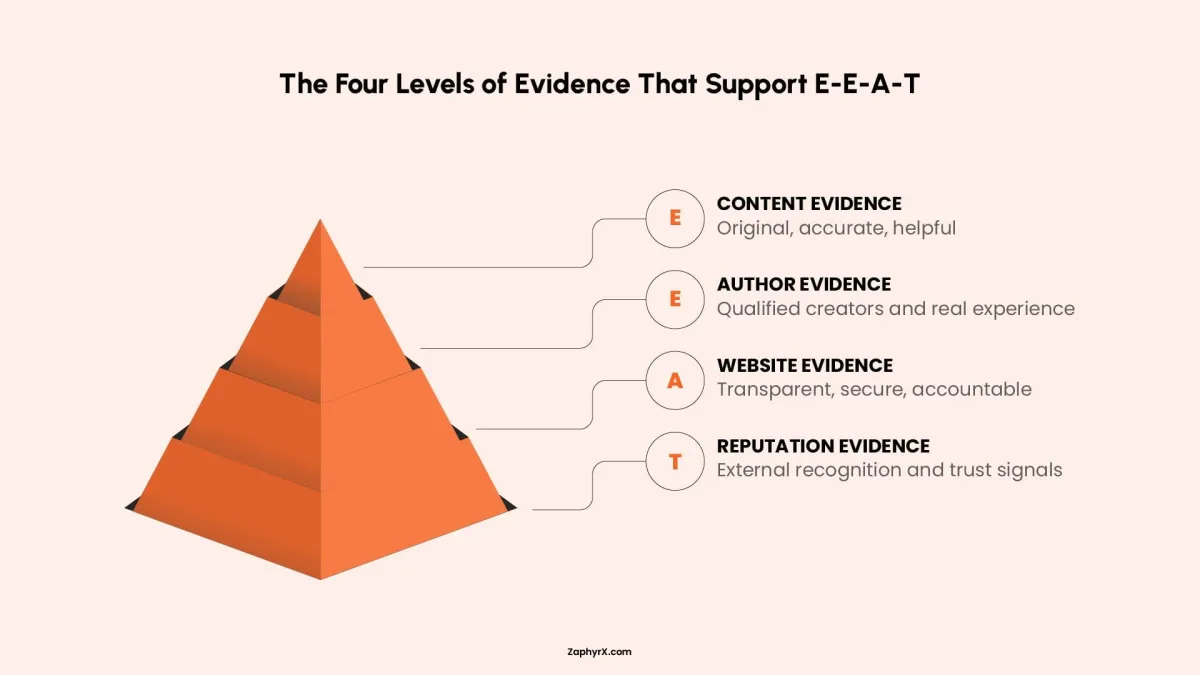
| Layer | What Google Looks For | Examples |
|---|---|---|
|
Content Evidence |
Original, accurate, and helpful content that satisfies search intent. |
First hand experience, original research, expert insights, comprehensive answers, credible citations. |
|
Author Evidence |
Proof that the creator has relevant experience or expertise. |
Author bios, professional credentials, certifications, published work, industry experience. |
|
Website Evidence |
Signals that the website is trustworthy and transparent. |
HTTPS, About page, Contact page, editorial policies, privacy policy, regularly updated content. |
|
Reputation Evidence |
Recognition from people and organizations outside your website. |
High quality backlinks, media mentions, reviews, awards, industry citations, positive brand reputation. |
Layer 1: Content Evidence
Every page should demonstrate value through original insights, accurate information, and content that fully answers the user’s question. Practical examples, case studies, testing, and supporting sources help distinguish your content from pages that simply repeat information already available elsewhere.
Layer 2: Author Evidence
Google wants to understand who created the content and why they’re qualified to discuss the topic. Detailed author profiles, relevant experience, certifications, and links to other published work help establish credibility and show that the content comes from a knowledgeable source.
Layer 3: Website Evidence
Trust isn’t built through content alone. A professional website with clear contact information, transparent policies, secure browsing, and consistent editorial standards signals that the business behind the content is legitimate and accountable.
Layer 4: Reputation Evidence
The strongest proof of authority often comes from outside your own website. Mentions from respected publications, editorial backlinks, customer reviews, industry awards, conference speaking engagements, and citations from trusted organizations all reinforce your credibility. When independent sources recognize your expertise, Google has additional evidence that your content deserves attention.
Google E-E-A-T Improvement Checklist
| Area | Action |
|---|---|
|
Experience |
Include first hand examples, case studies, testing, and original insights. |
|
Expertise |
Publish accurate, well researched content reviewed by knowledgeable contributors. |
|
Authoritativeness |
Earn quality backlinks, citations, media mentions, and industry recognition. |
|
Trust |
Use credible sources, secure your website with HTTPS, provide transparent author and business information, and keep content up to date. |
Improving E-E-A-T is an ongoing process rather than a one time optimization. As you continue publishing helpful content, demonstrating real expertise, and building your brand’s reputation, you strengthen the signals that both users and Google associate with high quality websites.
How to Demonstrate E-E-A-T With Real Evidence
Claiming that your content is trustworthy isn’t enough. Google looks for evidence that supports those claims. Every article, author, and website should provide signals that demonstrate real experience, expertise, authority, and trust. The stronger the evidence, the easier it is for users and search engines to view your content as credible.
E-E-A-T Evidence Checklist
| E-E-A-T Element | Weak Evidence | Strong Evidence |
|---|---|---|
|
Experience |
Generic advice based on research. |
Case studies, product testing, project outcomes, first hand examples, original photos or screenshots. |
|
Expertise |
Broad claims without proof. |
Professional credentials, technical knowledge, expert reviews, well researched explanations, cited sources. |
|
Authoritativeness |
Self-proclaimed expertise. |
Editorial backlinks, media mentions, industry awards, speaking engagements, published research. |
|
Trust |
Anonymous content and unsupported claims. |
Author bios, source citations, HTTPS, business information, editorial policies, updated content. |
Show, Don't Just Tell
Instead of stating that you’re an expert, provide proof. If you’ve completed a successful ERP migration, share the implementation process and the results. If you’ve tested a cybersecurity solution, include screenshots, findings, and lessons learned. Original evidence carries far more weight than broad claims because it demonstrates knowledge that can’t be copied from another website.
Support Important Claims
Whenever you reference statistics, industry trends, or best practices, back them with credible sources. For original research, explain how the data was collected so readers can understand the methodology. Supporting evidence increases confidence in your content and makes it easier for others to reference it.
Make Expertise Visible
Don’t hide your qualifications. Include detailed author biographies, professional certifications, years of experience, and links to relevant work. If an article has been reviewed by a subject matter expert, identify the reviewer and explain their role. Transparency helps readers understand why they should trust the information.
Strengthen Your Reputation Over Time
Some E-E-A-T signals come from outside your website. Editorial backlinks, customer testimonials, media coverage, conference presentations, and industry recognition all reinforce your credibility. These signals can’t be added overnight, but they grow naturally as you continue publishing valuable content and contributing to your industry.
Focus on Evidence, Not Claims
Anyone can say they’re experienced or authoritative. What separates high quality content is the ability to prove it. The more evidence you provide through original insights, verified sources, transparent authorship, and a strong professional reputation, the stronger your E-E-A-T signals become. Google’s goal is to reward content that demonstrates credibility, not simply content that claims it.
Does Structured Data Improve E-E-A-T?
Not directly. Structured data doesn’t increase your E-E-A-T or improve rankings on its own. Google has confirmed that adding schema markup is not a shortcut to demonstrating experience, expertise, authority, or trust. However, it helps search engines better understand your content, your authors, and your organization, making it easier to interpret the credibility signals already present on your website.
Google recommends using the correct author type and connecting the author to a valid profile through url or sameAs. Author pages may also use ProfilePage structured data where the page is primarily about one person or affiliated organization.
How Structured Data Supports E-E-A-T
| Schema Type | How It Supports E-E-A-T |
|---|---|
|
Person |
Identifies the author and their professional background. |
|
Organization |
Provides information about your business, brand, and official website. |
|
Article |
Helps Google understand article details such as the author, publisher, and publication date. |
|
Author |
Connects content to the person who created or reviewed it. |
|
Review |
Highlights genuine customer reviews and ratings where appropriate. |
|
FAQ |
Organizes question and answer content for better understanding. |
|
Breadcrumb |
Clarifies your website structure and improves content discovery. |
What Structured Data Can and Can't Do
Structured data helps Google identify who wrote your content, when it was published, and how different pages relate to one another.
For example, adding Person schema to an author page can reinforce that the author has relevant experience, while Organization schema provides additional context about your business.
However, schema markup cannot make inaccurate content trustworthy or turn an inexperienced author into an expert. If the evidence isn’t present on the page, structured data has nothing meaningful to communicate.
Build the Evidence First
The most effective approach is to create content that genuinely demonstrates E-E-A-T through first hand experience, expert insights, transparent authorship, and credible sources. Once those elements are in place, structured data helps search engines understand and connect that information more efficiently.
How Does E-E-A-T Apply to AI-Generated Content?
Google doesn’t rank or penalize content simply because it was created with AI. Instead, it evaluates whether the content is helpful, accurate, original, and trustworthy. AI generated content can perform well in search results if it demonstrates the same qualities Google expects from any high quality page.
The question isn’t “Was AI used?” It’s “Does the content satisfy E-E-A-T?”
AI Content Through the E-E-A-T Lens
| E-E-A-T Element | AI Alone | AI + Human Expertise |
|---|---|---|
|
Experience |
Cannot provide genuine first hand experience. |
Adds real case studies, testing, project outcomes, and practical insights. |
|
Expertise |
Can summarize existing information. |
Verifies facts, adds expert analysis, and explains complex topics accurately. |
|
Authoritativeness |
Doesn’t establish authority on its own. |
Benefits from expert authorship, brand reputation, and industry recognition. |
|
Trust |
May produce outdated or inaccurate information if left unchecked. |
Includes fact checking, credible sources, transparent authorship, and regular updates. |
AI Creates Content. People Create Credibility
AI is excellent at organizing information, generating outlines, and improving productivity. However, it cannot replace real world experience, professional judgment, or accountability. It doesn’t conduct original research, test products, work with clients, or take responsibility for the accuracy of its output.
That’s why human review remains essential. Subject matter experts should verify technical information, add practical examples, cite reliable sources, and ensure the content reflects current best practices.
Combine AI With Human Expertise
The most effective approach is to use AI as a writing assistant rather than an author. Let AI handle repetitive tasks such as drafting, summarizing, or organizing ideas, then strengthen the content with first hand experience, original insights, expert review, and evidence that only humans can provide.
Google’s guidance is clear: the quality of the content matters more than how it was created. When AI generated content is accurate, helpful, original, and backed by real expertise, it can align with E-E-A-T and perform well in search.
Common E-E-A-T Mistakes
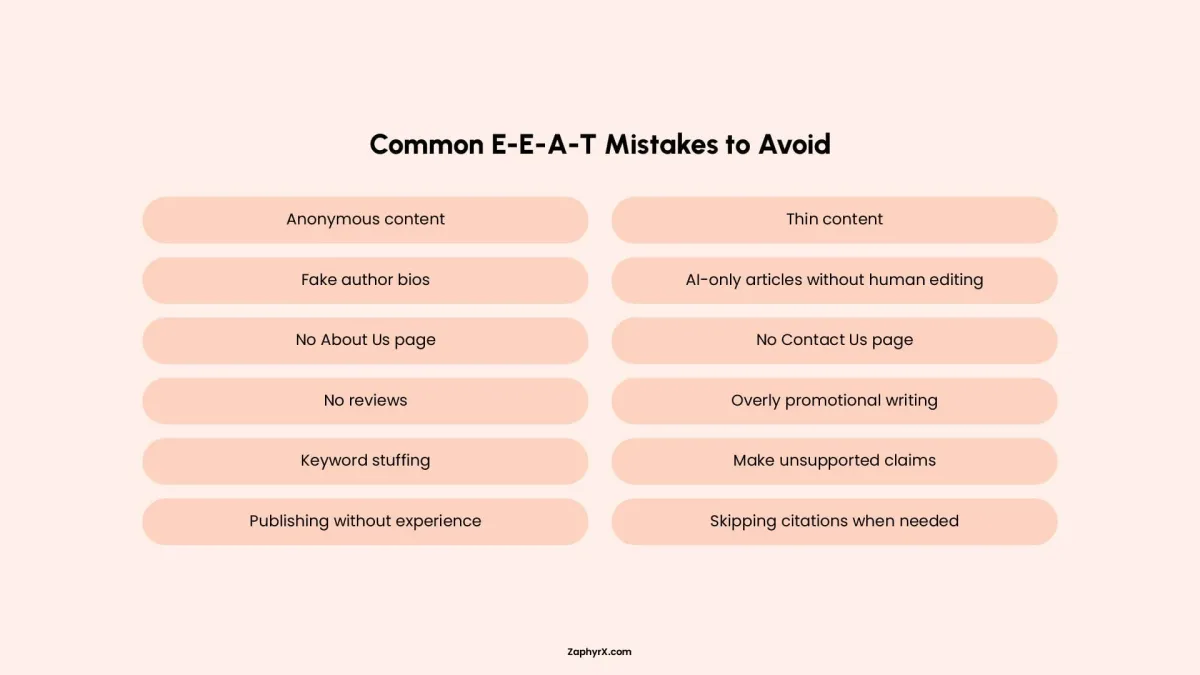
Many websites struggle with E-E-A-T not because they lack expertise, but because they fail to demonstrate it. Publishing high quality content is only part of the equation. You also need to provide clear evidence that your information is accurate, your authors are qualified, and your website is trustworthy.
Common Mistakes That Weaken E-E-A-T
| Mistake | Why It's a Problem | How to Fix It |
|---|---|---|
|
Publishing generic content |
Offers little original value and fails to stand out from competing pages. |
Add first hand experience, original research, examples, or case studies. |
|
Hiding author information |
Users and search engines can’t verify who created the content. |
Include detailed author bios with relevant credentials or experience. |
|
Making unsupported claims |
Reduces credibility and makes information harder to trust. |
Support important claims with reputable sources and evidence. |
|
Letting content become outdated |
Old statistics and obsolete advice can mislead readers. |
Review and update content regularly with current information. |
|
Prioritizing keywords over users |
Creates content that ranks poorly because it doesn’t satisfy search intent. |
Write to answer users’ questions first, then optimize for SEO. |
|
Ignoring website trust signals |
Missing contact details, HTTPS, or policies can reduce confidence. |
Maintain a secure, transparent, and professionally managed website. |
Writing Without Original Value
Many websites simply reword information that’s already ranking on Google. While the content may be accurate, it doesn’t provide users with a reason to choose your page over dozens of similar articles. Add original insights, practical examples, data, or lessons from real projects to make your content genuinely useful.
Overlooking Author Credibility
Publishing anonymous articles or providing little information about the author makes it difficult to establish expertise. Readers are more likely to trust content when they know who created it, what experience they have, and why they’re qualified to discuss the topic.
Treating E-E-A-T as an SEO Checklist
E-E-A-T isn’t something you achieve by adding an author bio or installing a schema plugin. It’s the result of consistently publishing accurate content, demonstrating real expertise, earning recognition from reputable sources, and maintaining a trustworthy website. Individual optimizations help, but they can’t replace genuine credibility.
Chasing Rankings Instead of Helping Users
The biggest mistake is creating content primarily for search engines. Pages overloaded with keywords, exaggerated claims, or AI generated filler may attract initial traffic, but they rarely build trust. Focus on answering real questions, solving real problems, and providing evidence that supports your recommendations. That’s the approach that aligns with both user expectations and Google’s definition of high quality content.
How to Audit Your Website's E-E-A-T

Improving E-E-A-T starts with understanding where your website already demonstrates credibility and where important signals are missing. An E-E-A-T audit helps you evaluate your content, authors, website, and brand reputation from the perspective of both users and Google. The goal isn’t to achieve a perfect score, but to identify gaps that could reduce trust or limit your search visibility.
E-E-A-T Website Audit Checklist
| Area to Audit | Questions to Ask | Action if Missing |
|---|---|---|
|
Content Quality |
Is the content original, accurate, and helpful? |
Add unique insights, update outdated information, and cite reliable sources. |
|
Experience |
Does the content include first hand examples, case studies, or testing? |
Add practical examples, screenshots, project outcomes, or lessons learned. |
|
Author Information |
Are the author and their qualifications clearly identified? |
Create detailed author bios and link to professional profiles or credentials. |
|
Trust Signals |
Does the site include HTTPS, contact details, and key policy pages? |
Publish or update your About, Contact, Privacy Policy, and Editorial Policy pages. |
|
Authority |
Is your website earning backlinks and mentions from reputable sources? |
Invest in original research, digital PR, and thought leadership content. |
|
Content Freshness |
Are statistics, references, and recommendations up to date? |
Review and refresh high value pages regularly. |
Review Your Highest Value Pages First
Start with the pages that have the greatest business impact, such as service pages, product pages, high traffic blog posts, and articles targeting competitive keywords. These pages are the most likely to influence search performance, making them the best place to strengthen E-E-A-T signals.
Look for Missing Evidence
As you review each page, ask whether it proves its claims or simply makes them. Strong content includes first hand experience, expert insights, credible references, and clear authorship. If a page lacks evidence, identify what could be added to increase its credibility.
Evaluate Website Trust Signals
Your website should make it easy for users to understand who you are and how to contact you. Check that important pages such as About, Contact, Privacy Policy, Terms of Service, and Editorial Policy are easy to find and contain accurate information. Also verify that your website uses HTTPS and functions properly across devices.
Assess Your External Reputation
Some E-E-A-T signals come from outside your website. Search for your brand online and review how it appears in search results, industry directories, news articles, and customer reviews. Positive mentions, editorial backlinks, and industry recognition strengthen your authority, while outdated or inaccurate information should be corrected where possible.
Turn Your Audit Into an Action Plan
An E-E-A-T audit should end with a prioritized list of improvements rather than a collection of observations. Start by updating your most important pages, strengthening author credibility, improving trust signals, and refreshing outdated content. Small, consistent improvements across your website build stronger E-E-A-T over time and create a better experience for both users and search engines.
E-E-A-T and Visibility in Google AI Overviews
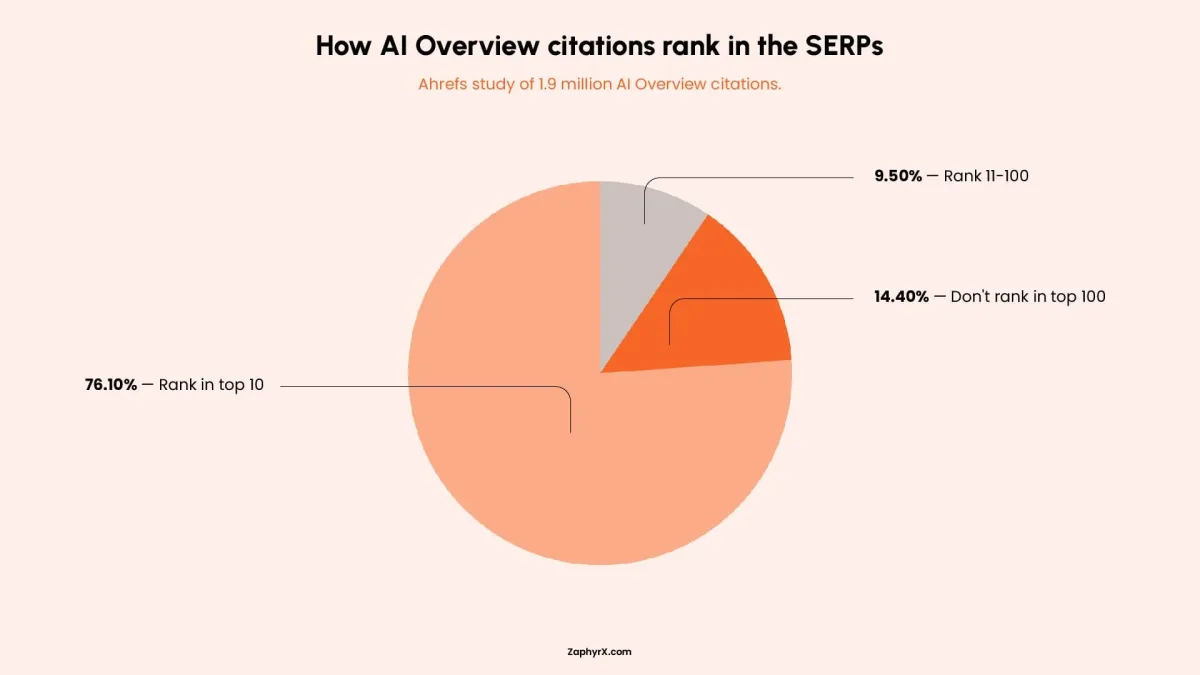
Google AI Overviews are designed to generate concise answers by synthesizing information from multiple trusted sources. While E-E-A-T is not a direct ranking factor for AI Overviews, the same qualities that improve search visibility, such as experience, expertise, authority, and trust, also increase the likelihood that your content will be referenced or cited.
AI systems aim to surface information that is accurate, well supported, and written by credible sources. Websites that consistently demonstrate these qualities are better positioned to appear in AI generated responses.
Google’s 2026 guidance says that existing SEO best practices remain relevant because its generative AI features are connected with Google’s core search ranking and quality systems. Google also emphasizes valuable, unique, non-commodity content rather than creating large numbers of pages for every possible query variation.
How E-E-A-T Supports AI Overview Visibility
| E-E-A-T Signal | Why It Matters for AI Overviews |
|---|---|
|
Experience |
Provides original insights, case studies, and first hand knowledge that AI cannot easily find elsewhere. |
|
Expertise |
Helps ensure technical and factual accuracy, especially for complex topics. |
|
Authoritativeness |
Increases confidence through strong brand reputation, quality backlinks, and industry recognition. |
|
Trust |
Demonstrates reliability with transparent authorship, credible sources, and accurate information. |
Original Content Has a Competitive Advantage
AI can summarize information that already exists, but it cannot replace original research, first hand experience, or unique industry insights. Publishing case studies, proprietary data, customer success stories, and practical frameworks gives your content something distinctive that AI systems are more likely to reference when generating responses.
Build Content Around Questions
Many AI Overviews appear for informational and question based searches. Structure your content around the questions your audience is actually asking, then answer them clearly and directly before expanding with supporting details. Using descriptive headings, concise definitions, tables, and step by step explanations makes your content easier for both users and search engines to understand.
Accuracy and Freshness Matter
AI Overviews prioritize reliable information. Regularly updating statistics, replacing outdated recommendations, and citing reputable sources help maintain your content’s credibility. For topics that evolve quickly, such as SEO, cybersecurity, healthcare, or finance, content freshness can be just as important as depth.
Optimize for People First
The best way to improve visibility in AI Overviews is not to optimize specifically for AI. Instead, focus on creating content that demonstrates genuine expertise, answers search intent thoroughly, and provides original value beyond what’s already available online. When your content consistently helps users make better decisions, it aligns with the same quality signals Google’s AI systems are designed to recognize.
Build Trust Before Trying to Build Rankings
Google E-E-A-T is not an SEO shortcut. It is a useful framework for evaluating whether content provides enough evidence of experience, expertise, authoritativeness, and trustworthiness for its purpose.
A strong website aligns four areas:
- The creator is appropriate for the subject.
- The content contains verifiable evidence.
- The business is transparent and accountable.
- Independent sources support its reputation.
The goal is not to make a page look as though an expert created it. The goal is to involve the right people, publish genuinely useful information, support important claims, and make the evidence visible.
ZAPHYRX can help evaluate authorship, content quality, sourcing, website transparency, topical authority, and editorial processes through a structured SEO content audit.
Request an E-E-A-T and content trust audit to identify the credibility gaps affecting your website’s content and organic-search strategy.
Frequently Asked Questions
Google does not provide website owners with a public E-E-A-T score. Third-party tools and internal audits may create their own credibility metrics, but these should not be presented as official Google measurements.
Experience means the creator has personally used, completed, visited, or encountered what they are discussing. Expertise means they possess suitable knowledge or skill. A product review may rely strongly on first-hand experience, while medical, financial, or legal guidance may require formal professional expertise.
YMYL topics can affect health, financial stability, safety, society, or major life decisions. Google says its systems place greater weight on strong E-E-A-T for subjects where inaccurate information could cause significant harm.
AI-assisted content can perform well when the final page is accurate, original, useful, appropriately reviewed, and created for users. However, AI cannot independently provide genuine first-hand experience or professional accountability. Google warns that generating many unoriginal pages without adding value may constitute scaled content abuse.
A detailed author biography can support transparency and help readers understand the creator’s suitability. It does not automatically improve rankings or compensate for weak content. The biography should include specific, verifiable experience rather than broad claims such as “industry expert.”
There is no universal timeline because E-E-A-T is not a single score. On-page improvements such as stronger sourcing and author transparency can be implemented quickly. Building external recognition, industry authority, a reliable publication history, and a strong reputation generally requires sustained work over time.